
24 April 2026
The most photographed alley in Vejer: the story of the Arco de las Monjas
The real story of Vejer de la Frontera's most photographed corner: why it was built, how to find it, the best time to photograph it, and everything worth knowing. Told by someone who works under it.
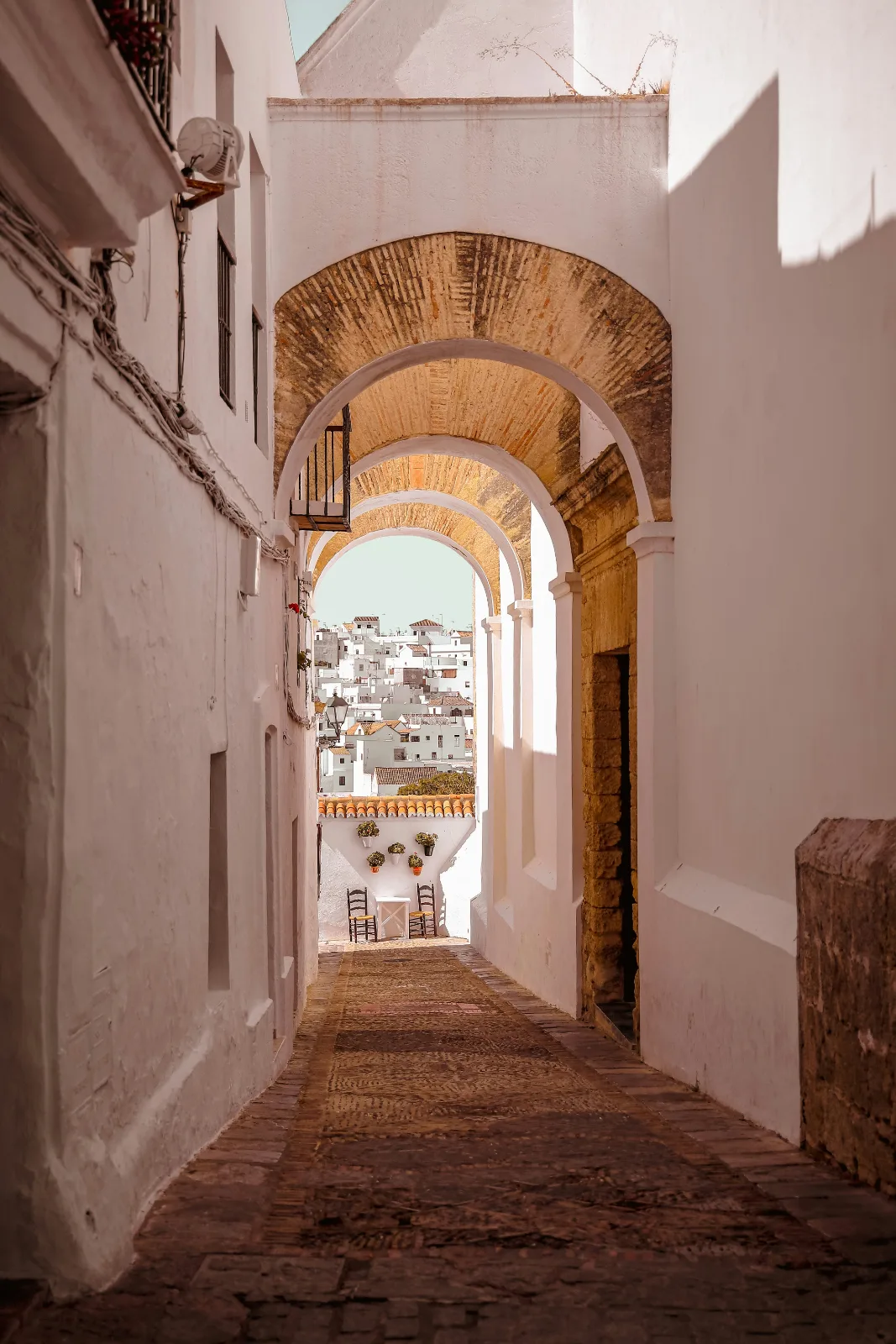
If you've seen photos of Vejer de la Frontera on Instagram, in a travel feature or on a postcard, there's one image you almost certainly recognise: a narrow white alley, cobblestoned, crossed by four semicircular arches that span from wall to wall. That image is the most photographed corner of the village. And, curiously, almost no one tells its story properly.
Understandable: the place has three different names, two earthquakes in its biography, and an architectural function that doesn't make sense until someone explains it.
I work at Restaurante La Judería de Vejer, located right under the last of those arches. Every day I see dozens of people stop in the middle of the alley, look up, and take the same photo. Some ask me what it's called, others what those arches are, others when they were built. After years of answering the same questions, I've decided to write it all down.
What is this alley actually called?
Ask three locals and you'll get three different names. All three are correct:
Arco de las Monjas ("Arch of the Nuns"): the most widespread popular name, especially outside the village. References the Concepcionistas nuns of the adjacent convent.
Callejón de las Monjas or Callejón de los Arcos de las Monjas: local variants of the same name.
Calle Judería ("Jewish Quarter Street"): the official name in the municipal street register. It's named this because it crosses the historic Judería quarter, where Vejer's Jewish community lived until their expulsion in 1492.
I'll use them interchangeably in this post. If you're using GPS, search for "Calle Judería, Vejer de la Frontera". If you ask someone for directions, they'll understand any of the three.
Why the arches were built: the story of two earthquakes
This is the detail almost no tourist source gets right. The arches aren't decorative: they're structural buttresses that support the lateral wall of the old Concepcionistas Convent. And they were built as a response to an earthquake. But not the one most people think.
The great Lisbon earthquake of 1755
On 1 November 1755, All Saints' Day, one of the most catastrophic seismic events in European history occurred. Its epicentre was in the Atlantic Ocean off the Portuguese coast, but its waves were felt violently across all of Andalusia. Vejer, sitting 200 metres above the Cádiz coast, suffered serious damage to its churches and houses. The bell tower of the nearby Iglesia del Divino Salvador had to be rebuilt after this quake, which explains its distinctive baroque tile-covered spire.
The Concepcionistas Convent also suffered, but held. Its walls and vaults remained standing. For a while.
The local earthquake of 12 April 1773
Eighteen years later, on 12 April 1773, a second earthquake struck Vejer. This one, unlike the Lisbon quake, was local: its epicentre was very close to the urban core itself. For Vejer's built fabric, this seismic event was what historians call "the end of an era and the birth of contemporary Vejer".
The convent, already weakened by the previous earthquake, didn't hold this time. The vault of the main chapel cracked, and the Gospel wall (the southern flank) threatened to collapse. If something wasn't done, the entire building could come down.
The solution was clever: instead of demolishing and rebuilding, four semicircular buttresses were raised across the street from one side to the other, anchored in the walls of the neighbouring houses. These buttresses transferred the wall's weight onto the structures opposite, preventing collapse.
The result, unintentionally, was one of Andalusia's most beautiful architectural corners. What was meant as an emergency solution became a symbol of the village.
Why it's so photogenic
There are beautiful corners in many white villages. What makes the Arco de las Monjas unique is the combination of several factors that rarely meet in one place:
The vanishing perspective
The four arches are aligned, separated by just a few metres, creating a vanishing perspective the camera captures with force. It's one of those places where any phone camera looks like a professional one.
The contrast of white and cobblestone
The walls are whitewashed (painted with lime) every year, maintaining an intense white that contrasts with the dark cobblestones below and the red geraniums hanging from some windows. It's the most distinctive colour palette of southern Spain.
The human scale
The alley is barely two metres wide. When a person passes under the first arch, they're framed perfectly. This makes shots with a human figure especially powerful — the ones that go viral on Instagram.
The views at the end of the alley
If you walk to the end of the street, you reach a section opening onto the outside of the historic centre, with views over the Cádiz countryside and, on clear days, towards the coast. It's one of those quiet rewards Vejer reserves for those who bother to walk all the way down.
How to reach the Arco de las Monjas
The alley is at the heart of Vejer's old town, next to the castle. If you come by car, you won't be able to drive to it: the historic centre is pedestrian-only. You'll have to park outside and walk up.
Recommended parking:
Plaza de España car park (underground, paid, inside the old town). 5 minutes' walk from the alley.
La Barca de Vejer (free, down on the N-340). Walk up via stairs or the public lift. 15-20 minutes' walk to the alley.
If you arrive by taxi or public transport, the main stop is at La Plazuela, also 5 minutes from the alley. For more details on parking and arriving, we wrote a practical guide to visiting Vejer by car.
Once in the old town, the route is simple: head towards Vejer Castle. The alley branches off from Calle Castillo, on the side of the Concepcionistas Convent. Ask anyone for "el Arco de las Monjas" and they'll point you there.
Best time of day to photograph it
If you're coming specifically for the photo, choosing your time matters. What I'm sharing here is what I've observed for years from the restaurant:
Early morning (8:00 - 10:00)
Best light for photography. The sun enters softly and casts gentle shadows under the arches. Almost no tourists at that hour: you'll have the alley to yourself. If you're staying in Vejer and you're an early riser, this is the best option.
Midday (12:00 - 15:00)
The busiest hour, especially in high season. The overhead light flattens volumes and makes capturing the alley's depth difficult. Avoid if possible if photography is your priority.
Golden hour (sunset)
An hour before sunset, the light turns golden and the white walls take on warm tones. It's the favourite hour of professional photographers. In summer, this means roughly between 20:00 and 21:30. In winter, between 17:30 and 19:00.
At night
The alley is lit by yellow streetlamps that create a very different, almost cinematic atmosphere. With a decent camera or a recent phone, night shots can be spectacular. Bonus: during the Noche de las Velas (Night of the Candles, first Saturday of September), the entire old town is lit only by candles and the alley becomes a magical scene.
What else to do nearby
The Arco de las Monjas isn't an isolated destination. It's surrounded by other places worth seeing while you're in the area:
Museum of Customs and Traditions of Vejer: inside the Concepcionistas Convent itself, right next to the alley. Cheap entry, short visit, gives context about the cobijadas (women in traditional veils) and the village's historic life.
Vejer Castle: 100 metres from the alley. Muslim origin (10th-11th centuries). Spectacular views from its battlements.
Mirador de la Cobijada: 200 metres from the alley, at the end of the street. Panoramic views southwards; on clear days you can see the Cádiz coast and even Morocco.
Judería neighbourhood: the alley is part of it. Wander the side streets, equally beautiful corners with fewer tourists.
And if you fancy eating or having a drink after the photo, our restaurant is right in the alley itself. We have a terrace with panoramic views over the white village and a menu of Andalusian cuisine with local produce. You can see our menu or book a table.
Frequently asked questions
How many arches does the alley have?
Four. All of the same style (semicircular), built at the same time in 1773. They have identical functions: supporting the convent wall.
Can you visit inside the Concepcionistas Convent?
Yes, today it houses the Museum of Customs and Traditions of Vejer. Entry costs €1. Hours vary by season; check with the tourist office in advance.
Why is it called "Calle Judería"?
Because it crosses the neighbourhood where Vejer's Jewish community lived until their expulsion in 1492. The whole area of the old town is known as the Judería.
Is there a fee or restriction for photographing the alley?
None. It's a public street, free to photograph. We just ask for respect for the residents: the alley is residential and people live there. Avoid noise at night and don't block the way for long periods.
Is the alley accessible for people with reduced mobility?
Partially. The ground is uneven cobblestone and the slopes are steep in the historic centre. A wheelchair with assistance can reach it, but it's not comfortable. Access from Plaza de España is the easiest.
Are there other equally photogenic corners in Vejer?
Several. Plaza de España, the viewpoints, Calle Silla Vieja with its geraniums, the Arco de la Villa, the Mirador de la Cobijada. Vejer is an open-air museum: stroll without rushing and you'll discover many.
To wrap up
The Arco de las Monjas is one of those architectural accidents that end up defining the identity of a place. An 18th-century emergency solution that three centuries later has become the visual symbol of Vejer de la Frontera.
If you come to photograph it, try to come early or at sunset. If you have time, don't stay just at the first arch: walk to the end of the alley and discover the views few visitors see. And if you want to crown your visit with a good Andalusian meal, book a table at Restaurante La Judería de Vejer: we're right under the last arch, with a terrace overlooking the white village.
Happy walking, and better photos.